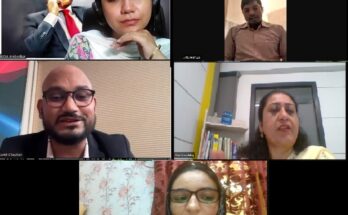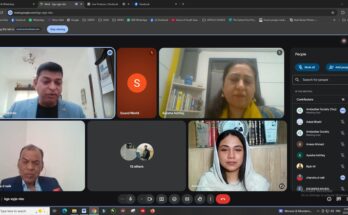
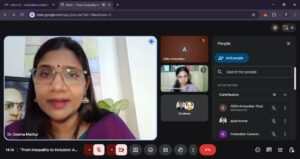





Ambedkar Society for South Asia (ASSA), in collaboration with the Jinnah-Ambedkar Chair at the Centre for South Asian Studies, University of the Punjab, organized an international webinar today on 16th April 2026 at 2:00 PM (PST).
The event was held in connection with the eve of Dr. B.R. Ambedkar’s Jayanti and was titled ”From Inequality to Inclusion: Ambedkar’s Path to Social Reform.” The webinar brought together distinguished speakers from India and Pakistan including:
- *Prof. Dr. Seema Mathur* Assistant Professor, Delhi University, Founder Member of NCWL India.
- *Bhante Sumit Ratan* Buddhist Monk, Activist, and Prominent Dhamma Preacher, India
- *Prof. Dr. Ajeet Kumar* Associate Professor, Dept. of History, Atma Ram Sanatan Dharma College, University of Delhi, India
- *Annie Namala* Social Activist , Director Centre for Social Equity and Inclusion, India 5- Dr. Ayesha Ashfaq Assistant Professor at the School of Integrated Social Sciences, University of Lahore, Pakistan
Prof. Dr. Seema Mathur in her speech, emphasized the deep-rooted nature of social inequality and highlighted education as a key tool for empowerment. She noted that Ambedkar strongly believed in education as a means of liberation and stressed that meaningful social reform requires a change in societal mindsets. She also pointed out that discussions on equality must confront the realities of caste and that inclusion can only be achieved through active and conscious participation rather than relying solely on policies. Bhante Sumit Ratan reflected on Ambedkar’s spiritual journey and his embrace of Buddhism as a path toward equality and dignity. He shared that Ambedkar found in Dhamma a framework free from discrimination and rooted in compassion. He emphasized that real social transformation requires both inner change and collective action, and that the teachings of the Buddha continue to offer guidance in addressing modern social challenges. Prof. Dr. Ajeet Kumar spoke about Ambedkar’s role as a visionary thinker and his significant contributions to history and democratic thought. He described Ambedkar as a leader whose writings continue to challenge conventional understandings of democracy and justice. He also stressed the importance of recognizing historical voices that resisted oppression and highlighted that Ambedkar’s legacy remains a powerful call for accountability and reform. Annie Namala focused on present-day inequalities and the importance of grassroots activism. She asserted that inclusion is a fundamental right rather than a privilege and emphasized the need to center marginalized communities in decision-making processes. She highlighted how Ambedkar’s ideas continue to inspire contemporary movements for social justice and called for collective responsibility in bringing about meaningful change. Dr. Ayesha Ashfaq discussed the relevance of Ambedkar’s ideas beyond India, particularly in the context of Pakistan and the wider South Asian region. She noted that the struggle for social justice is shared across borders and stressed the importance of creating inclusive spaces within educational and social institutions. She also remarked that such dialogues play an important role in fostering mutual understanding and regional cooperation. At the end of the session, a question/answer segment was conducted in which participants asked thoughtful and relevant questions.