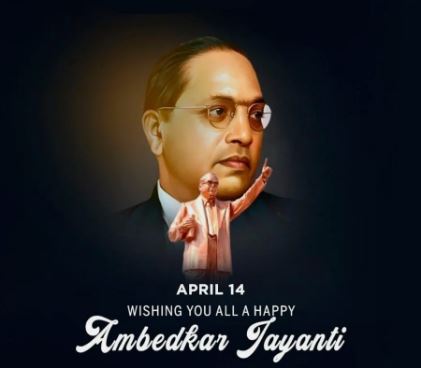
On the birth anniversary of B. R. Ambedkar, I offer this personal reflection shaped by years of engagement, observation and travel. This is not merely a tribute, but an attempt to revisit the life, ideas and warnings of Babasaheb as I have understood them.
Many people continue to believe that Babasaheb borrowed the ideals of liberty, equality and fraternity from the French Revolution. In my understanding, this is not correct. These values came to him through the life and teachings of the Buddha. When Babasaheb was a young boy, barely 10 or 11, a scholar named Krishna Rao Keluskar, a friend of his father, gifted him a biography of the Buddha at a felicitation organised by his community. That book, as I see it, gave a historic direction to his life.
Even before this, as a child, Babasaheb showed an extraordinary capacity to question. After reading the Ramayana and Mahabharata, he expressed his discomfort with the injustices embedded in them—whether it was the humiliation of Karna, the cutting of Eklavya’s thumb, or the treatment of Sita and Shambuka. To me, this early moral clarity explains the path he later chose.
Born into an “untouchable” caste, Babasaheb did not encounter discrimination as an abstraction but as a daily reality. From being made to sit outside the classroom as a child in Satara to being denied basic dignity even after returning from England with a doctorate, these experiences left a deep imprint. His inability to find housing in Baroda and his eventual resignation from service are not just incidents—they reveal the depth of social exclusion.
I see his struggles in the 1920s and 1930s as foundational to modern India. The Mahad Satyagraha of 1927, asserting the right of untouchables to draw water from a public tank, was not a small reformist step but a direct challenge to the social order. Similarly, the long and ultimately unsuccessful struggle for entry into the Kalaram temple in Nashik exposed the rigid resistance of orthodox forces.
By 1935, at Yeola, Babasaheb’s frustration had reached a decisive point. His declaration—though born a Hindu, he would not die one—was not rhetorical. Alongside it, he posed eleven fundamental questions to Hindu society about equality, humanity and fraternity. In my view, these questions remain unanswered even today.
The period between that declaration and his conversion in 1956 is also telling. Organizations like the Rashtriya Swayamsevak Sangh, founded in 1925, had decades to respond meaningfully to his critique. I have often asked: did they engage with his questions in any substantive way?
On 14 October 1956, at Nagpur, Babasaheb embraced Buddhism along with lakhs of followers. I see this not only as a personal spiritual decision but as a collective social transformation—a rejection of caste hierarchy and an embrace of an egalitarian ethic rooted in the teachings of the Buddha.
History, however, carries its own ironies. Barely two months later, on 6 December 1956, Babasaheb passed away. And on the same date in 1992, the demolition of the Babri Masjid took place—an event that, to my mind, symbolises the continuing tensions within Indian society.
In reflecting on Babasaheb, I am also reminded of earlier challenges to inequality, including that of the Buddha himself, who rejected hierarchical norms and founded a path based on equality. I also recall how even Swami Vivekananda observed that conversions in India were often driven by the oppressive conditions within caste society.
Babasaheb’s own description of Hindu society—as a multi-storeyed building without stairs—remains one of the most powerful metaphors I have encountered. It captures the absence of mobility and the permanence of hierarchy.
In recent decades, I have watched with concern the emphasis on “harmony” without equality. To me, calls for social harmony that do not address structural injustice risk preserving the status quo. At the same time, atrocities against Dalits continue across regions, raising uncomfortable questions about the gap between claims and reality.
Having travelled across regions including Pakistan, I have also seen how identities based solely on religion do not resolve deeper linguistic, cultural and regional diversities. These observations have strengthened my belief in Babasaheb’s warning: India’s diversity cannot be contained within a narrow, homogenising framework.
He had cautioned that turning India into a Hindu nation would lead to fragmentation. On this Jayanti, I find that warning as relevant as ever.
This tribute is, therefore, both remembrance and reflection. Babasaheb was not only the architect of the Constitution; he was a relentless critic of injustice and a thinker who transformed personal suffering into a universal call for dignity. Remembering him today means engaging seriously with the questions he raised—and recognising that the task he set before us remains unfinished.
Author: Dr Suresh Khairnar
Source: Counter Currents