Jijibisha (the will to survive)! The word ‘jijibisha,’ which carries an extremely deep meaning, kept touching my heart throughout the week.
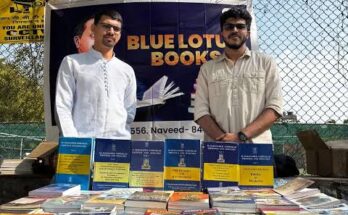
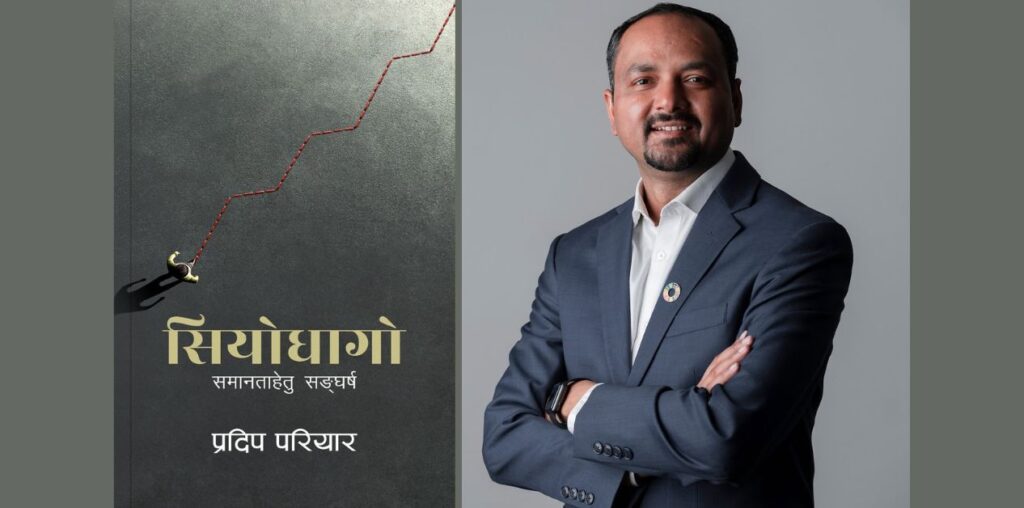
On June 28 during the release of the book Siyo Dhago on the final day of the Nepal America International Film Festival held in Maryland, United States, author Pradip Pariyar said, “My favorite powerful word is jijibisha. If it were not for this word, my journey would have ended long ago. It gave me the strength to live, fight, and move forward even in the most difficult circumstances. Even after losing everything in history, the jijibisha of Dalits did not die. Dalits are alive solely on the strength of their intense desire to live a meaningful life.”
Siyo Dhago weaves stories of the pain of caste discrimination experienced by the Dalit community and their relentless struggle against it. In it, the author connects his own experiences to tell the story of Nepali society. He has held up an unvarnished mirror to people showing their tragic behavior.
What is in a caste? Some educated people ask. However, a deep chasm of caste has been dug from within the very laws made by those educated people. Caste is history, culture, language, tradition, identity, and collective memory.
As Dor Bahadur Bista wrote in his book Fatalism and Development, “If a society does not emerge from the cycle of birth, caste, fate, sycophancy, and privilege, even if development plans change, the fundamental state of society will not change much.”
The caste system is not merely social discrimination; it is a structure that limits talent, labor, and opportunity. Much of the wave of physical or human development in present-day Nepal seems stuck in that very caste system. Siyodhago contains the story of human tragedy birthed by this very caste.
A long record of the murder of Nawaraj BK is presented prominently in the book. The place where Nawaraj and his friends were murdered was a Maoist stronghold. That incident shows how extremists there distorted the core slogan “The International shall be the human race.”
The book covers events ranging from the remarks of the then Home Minister Ram Bahadur Thapa ‘Badal’ after Nawaraj’s murder to the absurd logic offered by Janardan Sharma, elected from Western Rukum, claiming they jumped into the Bheri River themselves. Arriving at the press release issued 18 days after the incident, multiple layers of the upper-caste structure protecting the perpetrators are exposed.
The story of Sundar Harijan, who was taken from Nepalgunj to Rolpa, is equally painful. Detained in prison for 22 days over a minor dispute with the police, Sundar was prosecuted with demands for 1 year of imprisonment and a fine of Rs 10,000. The endless suffering endured by his family after his death is also included in the book.
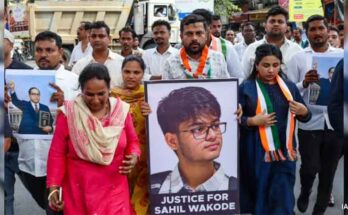
From Roshan BK, who lost his life in police custody in Kailali, to Bijay Ram, who was killed in Rautahat, these stories demonstrate the distance between Dalits and the state. As the author contends, the country belongs to Dalits as well, but the state failed to belong to Dalits. The book questions society: why did you draw lines of slavery, injustice, inequality, and discrimination between human beings by making them untouchables?
“Why did mother sit separately on the ridge of the field to eat snacks when going to work? Why did I have to wait for the guard brother when squirming with thirst and trying to drink water? Why couldn’t I serve and eat food myself?” Such powerful questions are present throughout the book. These are not his personal questions, but questions asked of society. Many such questions included in the book keep pricking like a needle.
While the author grew up experiencing discrimination in Khurkot, Sindhuli, I was in Dharan. I realize now that I grew up in Dharan from a young age with the status of a ruler. Now I understand; while the author had to wait for the guard brother to drink water when thirsty at school, I was over here playing the game of dumara baji.
In our school in Dharan, which had only five classrooms, classes were held outside on straw mats in an open field. Since the open field was our classroom, we played more than we studied. At that time, two group games were popular: hide-the-handkerchief and the other, dumara baji.
First, a dum had to be chosen. To decide who would be the dum, we first had to chant a spell-like rhyme by mouth, pointing at one person with each word as we counted. Whomever was pointed to as dum on the final word became the dum. Then, whoever they touched sequentially became dum. The simple counting chant recited while choosing the dum went like this: Ambal dambal khairepaat, darshan kuti, Mahadev, ora dora baandarko chhora chamchame bhatuwa, Damai, Dum.
The game learned upon going to school was played with great enthusiasm. However, the monster of discrimination was taught hidden within it. We probably played that game until Grade 8. Only when studying in college did I realize that discrimination was taught right through textbooks and sports. I do not know since when it was taught. I still remember by heart the dumara-choosing chant of the game played nearly 4.5 decades ago.
While reading Pradip’s book Siyo Dhago, I sobbed in many places. My heart grew heavy, and tears welled up unexpectedly. What if I had to experience what the author did?
Golche Sarki, who became a fine pawn of politics during the CPN (UML) era in Khurkot, had ended up becoming a guest at the author’s house. Sarki gained considerable notoriety in the fiscal year 1992/93 for slapping Ram Chandra Paudel in the then National Assembly. In a fit of anger because Poudel teased him while he was speaking, he slapped him. Due to this slap, he was suspended from the National Assembly for 15 days.
It can be understood that the CPN (UML) used him as a star for election campaigning and organizational expansion. 1 day, that very Sarki arrived to stay at the author’s house. His father, Krishna Bahadur Pariyar, was a government employee, head of the Area Post Office in Khurkot. He was the only government employee from the Dalit community. Upper-caste CPN (UML) leaders had arranged for Sarki to stay at Pariyar’s home in Khurkot. Even though he was a national leader of the CPN (UML), after all, he was still a Dalit in the eyes of others.
The author mentions the fact that Golche Sarki had to stay at Pariyar’s house precisely because communist leaders of other castes rejected him. The book Siyodhago describes without missing a single detail how caste grew hidden even among progressive communists who envisioned an international human race where everyone is considered of one caste.
The author’s family, grandfather Mahajan, and grandmother Krishna Maya, worked day and night for the high-caste patrons (Bista), yet never received proper value for their labor. The grandfather passed away after crushing so many of his desires. He worked all his life, but could not sew new clothes with needle and thread on his own sewing machine for his family during Dashain.
In his drunken state, grandfather reportedly used to say, “In the life of a Damai, everyone looked down on me, squeezed me, and oppressed me. But alcohol never looked down on me. As soon as you drink it, it hits.” Grandfather was one who knew the art of finding happiness within sorrow.
The havoc of caste endured by father Krishna Bahadur and mother Sita. Father believed that the light of education could break society’s caste pride. That was why he did not encourage his children to learn tailoring, which society looked down upon. He worked to spread the light of education to pull his children out of the quagmire of caste oppression. Father Krishna Bahadur’s desire to see his children’s beautiful future was cut short by his untimely death. The social oppression and mental torment experienced by the mother after the father’s death are also filled with pain. How tragic that after coming to Kathmandu, a situation was created where she had to lie about her caste in adult literacy classes!
Adding the Provident Fund money received after his father’s death to complete the purchase of a house in Kathmandu that had already been booked with earnest money, the author writes and hands over a check in his own name. However, because his caste was indicated right on the check, the homeowner returned the check and stated that they refused to sell the house simply because of his caste. This incident shows that caste discrimination persists deeply not only in villages but even among the wealthy urban class. After the plan to buy a house failed solely due to caste, the author too was left dumbfounded.
It was around 1983/84. I must have been seven or eight years old. In our small, one-story elevated attic house in Mangalbare, Dharan, guests were never lacking. My father, who migrated from Bhotechhap in Bhojpur to Dharan, was the first person from our village to do so. Having a home in Dharan was considered by the village to mean the son had made progress. Being able to welcome villagers at our home when they came down to Dharan was a matter of pride for my father. He considered it his duty to feed guests and help them reach their destinations.
One evening, my ritual father (mit buwa) arrived from Bhojpur. He sat on the veranda chatting with father. Mother was preparing food. During their conversation, my ritual father took a waistcoat out of his bag and handed it to father. It was neat and fitted as if tailored to measurement. Mother also praised it, saying it suited him.
After some time, father urged my ritual father to step inside the house. He hesitated a bit, but seeing the confidence on father’s face, he stepped inside. Both were happy, perhaps for breaking tradition with love and trust. Mother, however, was not happy.
The next day, mother scolded father severely and purified the house with gold-water (sunpani) and cow urine. From that very incident, I understood that there were people who were not allowed to enter our home.
Father appeared revolutionary. Was it because he lived abroad for many years? Was it due to the gift from his Damai ritual brother, or the colorful intoxication of alcohol? That day, father had challenged the so-called caste system.
When hearts torn over thousands of years are stitched together, they do not look the same, yet no one has the right to erase history. Darning is a necessity.
The idea that the society needle and thread connect becomes beautiful is the very thread of author Pariyar’s book. The idea that connects society is the needle. Author Pariyar’s Siyo Dhago made of words stitches together torn relationships.
Source: Nepal News