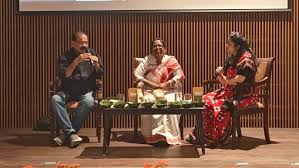
Rooted in the WCC’s longstanding conviction that “racism is a sin against God and a sin against fellow human beings” (WCC 5th Assembly, 1975), and reaffirmed by the WCC central committee’s 2009 declaration that caste-based discrimination is a crime and casteism a sin, the webinar called the global church and wider society into courageous truth-telling and transformative action.
Dr Amjad Mohamed Saleem, who moderated the webinar, noted that, across South Asia and beyond, casteism and racism have functioned as interlocking systems of dehumanization—ranking human worth, legitimizing exclusion, and normalizing violence against entire communities.
“Our focus on these intersections of caste, race, xenophobia, and other related forms of exclusion reminds us that discrimination is rarely experienced in isolation,” he said. “For many communities these injustices overlap; they shape the daily realities and the experiences in in ways that are very personal and profoundly structural as well.”
Speakers noted that, from the historic exclusion and oppression of Dalit communities, to the rise of white supremacist ideologies under colonialism, these systems have not only shaped societies but continue to fracture relationships today.
Rt. Rev. Dr Anderson Jeremiah, bishop of Edmonton, Diocese of London, Church of England, grew up within what is generally called a Dalit community.
“I’m one of the Dalit Christians to come through the pipelines of the church to emerge and to pursue academic interests, so my journey from there to here of course brings my experience of caste-based lived experience as well as in UK for the past 25 years living with racialized perceptions that we inhabit in this world,” he said.
Speakers also discussed how the COVID-19 pandemic-led surge in anti-Asian racism, and the persistence of anti-Black racism amid global migration, reveal that these injustices are neither distant nor dormant.
Rode Wanimbo, chairperson of the Women’s Department of the Evangelical Church of Indonesia, is an Indigenous person from West Papua.
“I think in the West Papuan context, the theme of this webinar is a deep problem that is rooted in historical and political disputes,” she said. “West Papua has been experiencing structural racism due to political conspiracy driven by economic interests.”
Speakers noted the ways in which discrimination affects churches, institutions, and everyday life across the world.
Rev. Dr Seoyoung Kim, WCC central committee member, Presbyterian Church in the Republic of Korea, University of Manchester, grew up in South Korea and now lives in the UK as a migrant.
“About a year ago, I was walking near my home with two Korean friends,” said Kim. “A group of teenage boys ran past and sprayed us with water guns. Maybe they thought it was funny, but I felt angry. But I chose not to react.”
Later, Kim kept thinking about it. “Was that racism or sexism or was I overreacting?” Kim asked. “The moment helped me understand something: the feeling was not new. I had learned it long before I moved to the UK.”
The webinar was part of a WCC series dedicated to building solidarities across regions, ethnicities, and struggles, affirming that liberation from racism, casteism, and gender injustice is both a spiritual mandate and a collective responsibility.
Source: Oikoumene