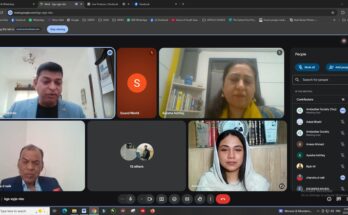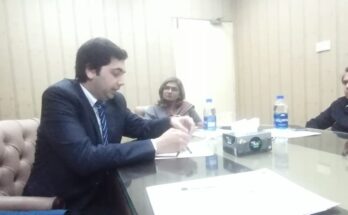


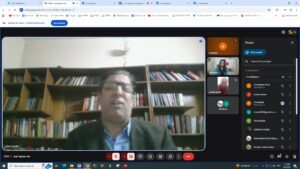
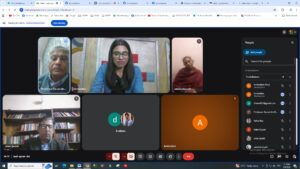
Ambedkar Society for South Asia (ASSA), in collaboration with the Jinnah-Ambedkar Chair, Centre for South Asian Studies, University of the Punjab, organized an international webinar on “Modern Form of Untouchability: Digital, Educational, Work Place & Institutional Spaces” on Friday, 9 January 2026, at 12:30 PM (PST) with following guest speakers :
1- DR. AMRITPAUL KAUR
Dental Surgeon, Masters in Dr Ambedkar Thought (Founding Member of National Council of Women Leaders, INDIA)
2- BOUDH VANDNA SOLANKI (Founder & MD Enlighten World Financial Literacy Program, INDIA)
3- RAHUL RAVI RAO (Senior Faculty, Department of Pali, University of Mumbai, INDIA)
4- UMAR JAVED (Analyst, Researcher, Journalist from PAKISTAN)
In her speech, Dr. Amritpal Kaur highlighted how untouchability has adapted itself to modern professions and digital platforms. She emphasized that discrimination today often appears in very diverse forms such as academic gatekeeping, professional isolation and denial of opportunities. Drawing from Ambedkarite thought, she stressed that social justice cannot be achieved without dismantling caste privilege embedded within institutions. She also underlined the role of women leaders in challenging caste hierarchies and reclaiming dignity. She stressed the need for academic research and policy frameworks that explicitly address caste as a form of systemic injustice. She also pointed out the importance of cross-border dialogue on caste and social exclusion. Boudh Vandna Solanki spoke about economic exclusion as a powerful modern expression of untouchability. She explained how lack of financial literacy, denial of credit and informal discrimination in banking and entrepreneurship spaces disproportionately affect marginalized communities. She argued that financial empowerment is a crucial tool of resistance against caste oppression. According to her, economic independence strengthens social assertion and challenges inherited hierarchies. Rahul Ravi Rao focused on educational spaces as sites where caste discrimination is often normalized. He discussed how language, curriculum, classroom behavior and institutional culture frequently marginalize Dalit and Bahujan students. He noted that the absence of Ambedkarite and anti-caste perspectives in mainstream education reinforces exclusion. He emphasized that education must become a space of liberation rather than silent humiliation. He discussed untouchability through a sociological and institutional lens, particularly in South Asian contexts. He highlighted how state institutions, welfare systems, and social services often fail to recognize caste-based discrimination as a structural issue. Umar Javed analyzed how modern media, digital platforms and public discourse reproduce caste biases. He explained that digital spaces, while appearing neutral, often amplify exclusion through trolling, silencing and selective visibility. He emphasized the responsibility of journalists and researchers to expose structural discrimination rather than individualize it. He also mentioned that the caste-based discriminations still prevailing in India, Pakistan and around South Asian region which need to be addressed on every forum. He also highlighted the growing role of digital activism in challenging caste oppression. At the end of the webinar, an interactive question-and-answer session was held, during which audience members raised thoughtful questions related to digital discrimination, institutional accountability and strategies for resistance. The speakers responded by offering critical insights and practical reflections, making the session both engaging and intellectually enriching.
Watch Full Video Here:
https://www.facebook.com/share/v/1GDXEpQtn7/