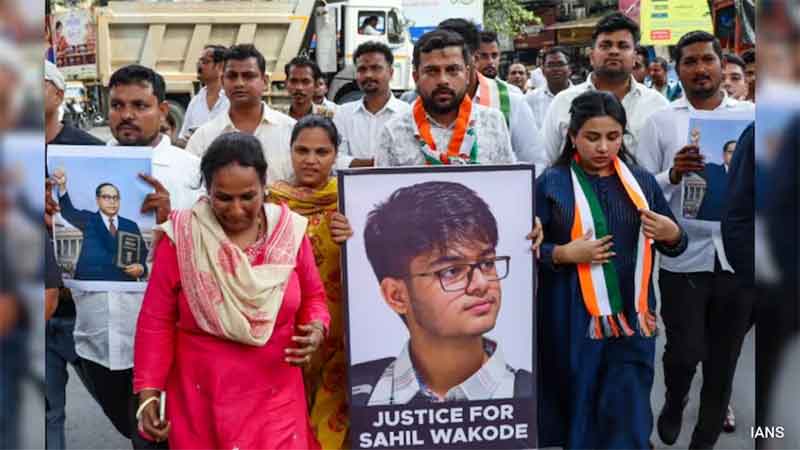
Sahil Wakode, a dalit student at IIT Bombay, committed suicide on September 18, 2026. His death has since triggered protests, allegations of caste based discrimination. A Professor named in the FIR, has subsequently been sent on leave, pending Institutional inquiry.1
There is something obscene about a university that calls itself a temple of learning while some of its students come to experience it as a killing field.
The universities and IITs are supposed to be the place where inherited identities lose their authority. A student enters with a surname, a village, a family history and a caste; he ought to leave with knowledge, intellectual confidence and the freedom to become someone other than what birth prescribed. The laboratory should know no caste. The equation should not ask who solved it. The library should not enquire into ancestry. The seminar room should recognise an argument, not a genealogy.
Yet in India, the universities and IITs and IIMs often become the place where the contradiction between constitutional citizenship and society is made brutally visible.
The admission letter says: You belong here.
The social order whispers: who allowed in?
The professor says: Merit
The student hears: Reservation.
The Constitution says: Equality.
The campus may answer: Know your caste.
And sometimes, after humiliation has accumulated beyond endurance, the student disappears from the university altogether – not by graduating, but by dying.
This is the meaning of the title “The Killing Fields of Learning.” In addition to the visible and invisible caste humiliation, academic pressure, financial stress, loneliness, family circumstances, psychological stress and many other factors may contribute to suicide.
The question is not whether every suicide is caused by caste. The question is why caste so repeatedly appears in the history of deaths, exclusions, humiliations and institutional conflicts involving students from lower-castes.
And why, when caste is alleged, institutions so often find it easier to search for an individual defect than to interrogate the institution itself.
1. Rohit Vemula: The student who was not meant to be.
Rohit Vemula’s death at the University of Hyderabad in January 2016 remains the most powerful symbol of this contradiction. His case cannot responsibly be reduced to a single uncontested causal narrative. In 2024, the Telangana Police filed a disclosure report disputing his SC status and finding insufficient evidence to hold the accused responsible. Following objections from his family, the police announced that further investigation would be sought. The legal and factual controversies therefore remain important.2
But, the institutional history surrounding Vemula’s death cannot be erased by a closure report.
Before his death, he and four other students associated with Ambedkar Students’ Association had been suspended. Their access to parts of the university was restricted, and Vemula’s fellowship had reportedly remained unpaid for months. The university’s subsequent investigation and the wider political controversy became inseparable from questions of caste, student politics and institutional power.3
His famous final letter became a devastating philosophical document precisely because it spoke of the experience of being reduced from a human being to an identity. The tragedy of Vemula is therefore larger than the legal question of whether every allegation against every individual is proved.
It asks:
What happens when an institution tells a student that he is formally equal while its disciplinary, administrative and social machinery makes him experience himself as expendable.
That is a question no university can evade by producing a psychological explanation.
2) The dead do not submit institutional complaints.
One of the most convenient arguments used after a student’s death is:
“There was no formal complaint”.
Then, must the murdered conscience first submit a memorandum before it may be heard?”
A student who is humiliated by an upper caste professor may not complain to another upper-caste professor. A student who believes the entire institutional hierarchy is socially hostile may not trust the institution’s grievance mechanism.
A first-generation student may not know which office to approach. A scholarship-dependent student may fear retaliation. A student already marked as “weak”, “undeserving” or “reservation-dependent” may reasonably fear that a complaint will confirm the stereotype against which he is struggling.
The absence of a complaint is therefore not necessarily evidence of the absence of discrimination. Indeed, sometimes it is evidence of something more disturbing— the student’s belief that there is nowhere to complain.
The UGC’s own regulations recognise caste discrimination in higher education broadly, including distinctions or exclusions that impair equality of treatment, and require institutions to take steps against caste-based discrimination and harassment.4
The question, then, is not merely whether a university possesses an anti-discrimination cell. The question is whether a student believes that the cell will protect him.
3) The institutional grammar of humiliation
Caste humiliation is rarely limited to spectacular insult.
It can be microscopic.
A professor repeatedly questions a student’s competence.
A supervisor delays approval.
A research guide becomes mysteriously unavailable.
A student’s scholarship is treated as charity.
A classmate asks his caste and then asks how he obtained admission
Someone jokes about reservation.
Someone says: “You got in because of quota.”
A student’s excellence becomes evidence against him, his failure evidence for the stereotype. When answers well, suspicion whispers, “he has copied”. When he answers poorly, they call it proof of his lack of merit.
The student is constantly required to demonstrate that he deserves to be where he is.
This is the cruelty of permanent examination.
The upper-caste student is allowed to be an individual, irrespective of whether he sometimes succeeds and sometime fails.
The lower-caste student can be made to feel that his every failure is evidence against his caste and his every success is evidence of the reservation system. He is not simply taking examinations. He is being examined as a caste.
That is a different psychological burden. And it is precisely here that Shakespeare’s tragic imagination becomes useful.
Othello is never allowed simply to be Othello. His identity is continually mediated through the racial imagination of Venice.
The caste-marked student experiences a related, though historically distinct problem, he is never permitted simply to be a student.
He becomes the reserved student.
The quota student. The backward student.
The beneficiary.
The outsider.
The exception.
4) The University’s Shakespearean tragedy.
Shakespeare knew something modern institutions sometimes forget.
A tragedy is rarely produced by one villain.
It is produced by an arrangement of circumstances to which ordinary decisions accumulate until they become fatal.
Othello is not destroyed by one sentence.
King Lear is not destroyed by one insult.
Hamlet does not die because of one conversation.
Tragedy is cumulative. So can institutional humiliation be.
A single remark may be survivable.
A single bad grade may be survivable.
A single rejection may be survivable.
But what happens when they accumulate?
A student begins to hear one message: You do not belong.
Then the university becomes not a place of learning but a theatre in which the student must continually defend his right to exist.
The institution may defend itself:
”We never told him to die.”
But that is not the only question. The deeper question is:
What did we repeatedly tell him about his worth?
5) Ambedkar enters the classroom.
Ambedkar would have regarded this as a fundamental failure of democracy. For him, political democracy could not survive indefinitely without social democracy. The citizen cannot be constitutional equal while socially ranked. And the university is one of the places where that contradiction becomes particularly visible.
Ambedkar’s great insight was that caste is not simply a collection of prejudices. It is a system of graded inequality. There is no single oppressor and a single oppressed caste. There are layers. Each group may stand above another and below a third. The result is a social order in which solidarity itself becomes difficult.
Therefore, the objective is not merely to make the caste system kinder. It is to annihilate caste system, without leaving any trace.
6) The Shakespearean question.
Shakespeare would finally ask the university.
What is a student.
A number?
A rank?
A scholarship?
A category?
An admission quota?
No. A student is a human being in the process of becoming.
And caste is precisely the system that attempts to decide in advance what that becoming may look like. The tragedy occurs when the university, instead of freeing the student from that destiny, reproduces it.
7) The Miltonian indictment.
John Milton would summon the university before the tribunal of liberty.
The charge: You promised education but reproduced domination.
The university would reply: “We gave him admission”.
Milton: “Did you give him dignity”
University: “We gave him a scholarship!”
Milton: “Did you give him belonging?”
University: “We gave him equal academic rules”.
Milton: “Were the social conditions under which those rules operated equal?”
Silence.
Then Ambedkar would ask the final question: “Was he treated as a citizen, or as a Caste?”
That is the question Indian higher education must answer.
The dead are not merely statistics.
They are failed futures.
They are unwritten books.
Unfinished dissertations.
Unheard lectures.
Unasked questions.
Lives that might have altered the very institutions that could not protect them.
Shakespeare would call it a tragedy.
Milton would call it domination.
Ambedkar would call it the unfinished work of social revolution.
And the university should call it by the proper name: a failure of equality.
”Indian government has no reliable national register of “caste suicides” in higher education. It records the bodies but not the caste relations that may have caused their deaths. The result is a peculiar epistemic erasure; the caste of the student is recorded statistically, while caste as an institutional experience is dissolved causally.
If the student enters the university only to discover that caste has followed him through the gate, if “merit” becomes a language with which his presence is questioned, if humiliation becomes part of institutional life, and if someone finally find death, preferable to continuing the struggle—then the political struggle cannot end with securing admission.
The heartbreaking tragedy is that Dalit and OBC students clutching their university certificates of admission with joy and pride so proudly, do not know. What is concealed behind them: a warrant of death.
The Silence of Mandal Heirs.
There is a peculiar tragedy unfolding in India’s Universities. The very institutions that were expected to open the doors of equality are becoming, for many Dalit and OBC students, places from which some never return. According to central Government figures, 122 students in higher educational institutions died by suicide between 2014 and 2021, of whom 68 belonged to the SC and ST communities and the remainder to the OBCs. Each number conceals a young life, a family devastated and a future extinguished.
But there is another tragedy, quieter and perhaps more revealing: the silence of those who claim to represent the political descendants of Mandal.
What, one wonders, are Akhilesh Yadav and Tejashwi Yadaw waiting for?
Not for another election, presumably. The dead have already voted, though in the only election from which there is no return.
This is not to accuse them of complicity with those responsible
Mandal was not merely a governmental formula for distributing seats. It was a historic rupture. It told the lower castes that the university was no longer to remain the hereditary preserve of the twice-born. Dalits, too, entered these institutions after decades of constitutional struggle and democratic mobilisation.
Mandal opened the gates. The question is whether anyone will now defend those who have entered.
Here Shakespearean irony becomes almost irresistible. The king is dead; long live the king. In the theatre of electoral politics, perhaps the slogan should now read: the student is dead; long live social justice.
The speeches remain. The anniversaries remain. The photographs with Ambedkar remain. The arithmetic of Yadav votes remain. What seems strangely absent is the thunder.
Where is the mobilization?
Where is the parliamentary storm?
Where is the demand for an independent national enquiry into caste discrimination in higher education?
Where is the movement that tells Dalit and OBC students: You entered these universities through a democratic fight, and nobody has the right to make you feel that you entered by trespassing?
This is where the silence of the Mandal heirs becomes politically painful. They possess something far more important than microphones: they possess the capacity and responsibility to turn scattered grief into collective political force.
The ‘killers’ should not be allowed the comfort of anonymity. The university should know that every humiliation can become a public question; every discriminatory act can become a political issue; every student death can become a summons to accountability.
Yet instead, there is an eerie quiet. And perhaps the most Shakespearean question is therefore not “who killed these students?” but
”Who will speak for the dead?”
For when politicians inherit the language of Mandal but lose the voice of mobilisation, something extraordinary happens: the oppressed acquires representation without acquiring a representative voice. The charge – if one may call it – is more subtle and more devastating, political ineptitude in the face of a catastrophe affecting the very social constituencies from which their politics derives its legitimacy.
It is not betrayal. It is the silence of those whose voices should have thundered.
The unequal geography of Death in Indian Universities
There is a striking and insufficiently documented fact about student suicides in India’s universities and elite institutions: while individual suicides occur among students of every social background, there has been no comparable public record of a massive or recurrent concentration of upper-caste suicides of the kind repeatedly documented among Dalit, Adivasi and OBC students. This asymmetry should not be treated as statistical trivia. It demands an inquiry into the unequal social conditions under which academic failure, humiliation, exclusion and despair are experienced.
The crucial question, therefore, is not simply who commits suicide, but under which social conditions does academic failure become existential humiliation? For an upper-caste student, failure may remain a nerve-wrecking personal experience. For a Dalit or OBC student, however, failure can be accompanied by the accusation that he or she entered the institution through “reservation”, that merit properly belongs to others, or that academic difficulty confirms an inherited social hierarchy. The student is thus compelled to carry two burdens simultaneously: the burden of academic competition and the burden of defending his or her very right to belong.
This is why the language of individual pathology can become politically convenient. Depression, academic pressure, family problems, or personal vulnerability may be genuine factors, but they can also become explanatory screens behind which institutional structures disappear. Research on caste and mental health in Indian higher education has specifically warned that the deaths of Dalit students are too readily individualised, thereby allowing institutions to evade questions of caste discrimination and institutional responsibility.6
The comparison with upper-caste students is revealing. Their individual tragedies must never be minimised. But the absence of an equivalent pattern of caste-based vulnerability among them raises a fundamental sociological question: why does the institution appear to become a far more dangerous social terrain for students who enter it from historically subordinated sections?
The gravest indictment, therefore, is not that some students die. It is that the social identity of the student may determine how much degradation he or she must endure before the university recognises the suffering as suffering at all.
Source: Counter Current