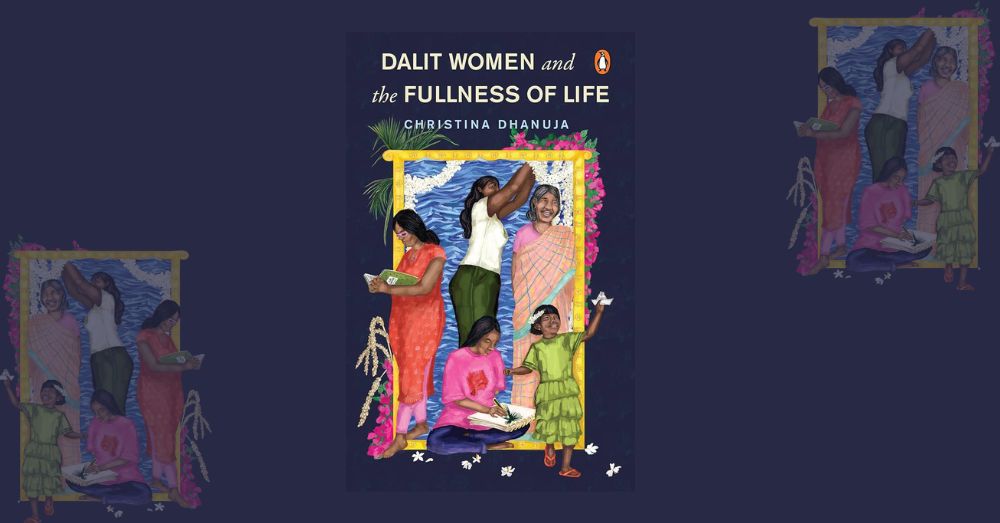
Christina Dhanuja’s Dalit Women and the Fullness of Life opens with Ambedkar’s piercing question, not whether a community lives or dies, but on what plane it lives. That question does not function merely as epigraph. It flows through the entire book. From the outset, Dhanuja makes clear that this is not a book to chronicle caste oppression, nor one willing to frame Dalit women only through suffering, endurance or even heroic resilience. It asks a far more difficult and expansive question: what would it mean for Dalit women not merely to survive, but to live fully?
That, to me, is the book’s quiet but radical intervention. It insists survival is too small a horizon.
What I admired most in this book is Dhanuja’s refusal of reduction. Very early on, the book signals this through a set of unsettling theological and political questions that stayed with me: How is suffering redemptive to a Dalit woman? What does salvation mean to families that do manual scavenging for a living? These are not rhetorical flourishes. They announce the seriousness of the project. They make clear that Dhanuja is interrogating not only caste and patriarchy but inherited moral and religious vocabularies themselves.
Again and again she resists familiar scripts through which Dalit women are narrated, as victims, as symbols of pain, as embodiments of resilience, as political abstractions. Instead, she insists on complexity. Dalit women emerge here as desiring, grieving, vulnerable, angry, joyful, sensual, thinking, contradictory human beings. That insistence feels deeply political. It is perhaps captured most powerfully in the line that stayed with me long after finishing the book: “I’d rather that Dalit women be human… Just human. Fully human. Working a little, resting a bit, living a lot more.” This I think is the ethical center of the book.
One of the book’s great strengths is the way memoir, structural critique and theological imagination are woven together. Dhanuja often moves from intimate anecdote to systemic analysis and then toward liberative imagination. That movement gives the writing much of its force. The personal is never merely confessional. The analytical is never detached. The theological is never abstract. They deepen one another.
Another striking feature of the book is its refusal to romanticize strength. This may be one of its most original contributions. There is a powerful challenge here to narratives that celebrate Dalit women only through endless endurance. Dhanuja asks what it would mean to imagine liberation not only as justice or representation, but as the right to fragility, softness, rest and pleasure. I found this profoundly moving. It expands political discourse in unexpected ways.
For me, the book reaches extraordinary force when it reclaims domains often denied serious place in liberation discourse: the body, desire, faith and joy. These chapters were the most powerful in the book for me because they push beyond critique into a fuller anthropology of freedom.
The writing on embodiment is especially remarkable. The body appears not only as a site marked by caste violence but also as a site of vulnerability, intelligence, sacredness and possibility. There is tremendous power in Dhanuja’s insistence that Dalit women cannot be reduced either to violated bodies or heroic workhorses. They are entitled to ordinary humanness.
The chapter on desire was one of the book’s strongest interventions. It is bold, tender and politically astute in ways I did not anticipate. Dhanuja treats desire not as private digression from caste politics but as central to what full humanity entails. That felt deeply original to me. I was especially moved by her refusal to cede love, sensuality and erotic possibility to those historically permitted personhood.The chapter quietly insists that pleasure too belongs within liberation.
There is also a beautiful continuity in how the book moves from body and desire to trauma, faith and joy. Even when addressing pain, Dhanuja resists allowing injury the final word. One sees this too in her writing on sisterhood, especially in the line that resilience is built through “layers and layers” of women who have laid bedrock for those who come after. That image stayed with me because it captures the book’s larger method: survival is collective, but so is flourishing.
And then there is joy.
I loved that joy in this book is not treated as sentimental optimism, reward after struggle, or escape from political reality. It is something harder won than that. Something collective. Almost insurgent. That felt deeply important. Too often discourses of liberation stop at survival or resistance. Dhanuja insists joy belongs there too.
That insistence is what makes the title The Fullness of Life feel earned rather than aspirational. Fullness here does not mean abundance in a shallow sense. It means the right to beauty, pleasure, community, sensuality, healing, faith, laughter and rest.
The book is also intellectually ambitious. It raises difficult questions not only about caste oppression but about labour, solidarity, community, feminist politics and healing itself. I appreciated that it often unsettled even progressive vocabularies. It does not offer easy consolations.
What lingered most for me after finishing the book was how much it expands the meaning of liberation. Not as access alone. Not as resistance alone. But as fullness.
Source: Youth Ki Awaz