

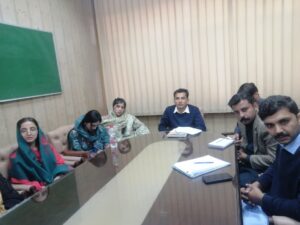


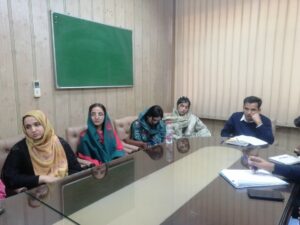
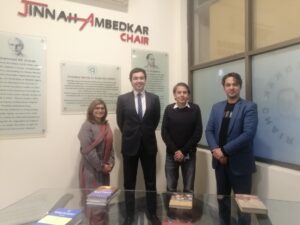
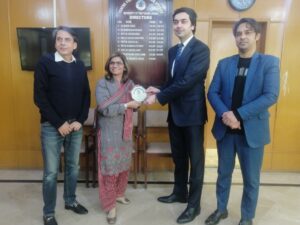
The Jinnah-Ambedkar Chair, in collaboration with the Centre for South Asian Studies, University of the Punjab, organized an academic lecture on 11th February 2026 at 11:30am, on the topic “Jinnah and Ambedkar: Competing Visions on Freedom.” Lecture was organized at Jinnah-Ambedkar Chair, CSAS, the University of the Punjab, Lahore. The guest speaker was Barrister Asad Rahim Khan, Advocate, Supreme Court of Pakistan. In his speech, Barrister Asad focused on the visions of Quaid-e-Azam Muhammad Ali Jinnah and Dr. B.R. Ambedkar regarding freedom, liberty and social liberation.
The speaker highlighted that both leaders shared significant similarities in their line of thought, particularly concerning the protection of minority rights and the struggle to secure equal status for marginalized and oppressed communities. However, their ultimate political approaches differed. Quaid-e-Azam ultimately pursued the creation of a separate state as a solution to safeguard minority rights, whereas Dr. Ambedkar sought to secure equal rights for Dalits and other oppressed classes within India through constitutional and legal means. He also shed light on Dr. Ambedkar’s role in drafting the Constitution of India, through which he presented a framework for a just and inclusive society. Nevertheless, it was noted that constitutional provisions alone have not fully transformed societal mindsets and caste-based discrimination continues to persist. Dr. Ambedkar’s decision to embrace Buddhism toward the end of his life was discussed in this context, reflecting his dissatisfaction with the caste system and his commitment to social justice.
He consistently emphasized peaceful and constitutional struggle, education and awareness as the primary means of achieving meaningful social change. The speaker elaborated on the distinctive qualities and intellectual contributions of Dr. B.R. Ambedkar, with particular emphasis on his comprehensive vision of equality. He discussed Ambedkar’s academic pursuits, writings and various courses of study, as well as his influential lectures, highlighting how deeply informed and multidimensional his thought process was.
The speaker explained how, even during his own time, Ambedkar consistently raised his voice for the rights of the oppressed classes, Dalits and minorities. He not only advocated for them at higher constitutional and political forums but also engaged with communities at the grassroots level, mobilizing people and addressing the injustices and discrimination they faced. His contribution was described as remarkable, especially his emphasis on social democracy, which he considered essential for the success of political democracy. Ambedkar firmly believed that political democracy could not survive without social democracy, and it was this guiding principle that shaped his lifelong struggle and enduring legacy.
The event was also attended by Madam Naheed Goraya, Chairperson of the Centre for South Asian Studies and Mr. Shaheen Hassan, Director of the Ambedkar Society for South Asia. Students and faculty members participated actively in the lecture. A productive question-and-answer session followed, during which participants raised thoughtful questions that were comprehensively addressed by Barrister Asad Rahim Khan. The lecture proved to be a meaningful and successful academic engagement, providing participants with valuable insights into the intellectual and constitutional history of South Asia.